Dras

Dras

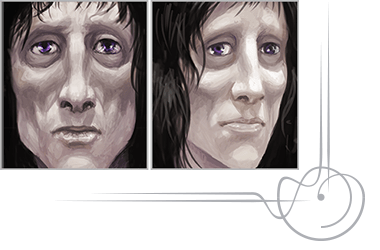
There is a common ancestry among the Dras and Janoa tribes leading to similarities of stature, such as their tall height and specialized eyes. However, they parted ways long enough ago that further adaptations occurred upon migrating to the swamps. Standing a bit taller and lankier than their ancestors, the Dras average about 6'5" (195cm) and, at roughly 125-150 lbs (57-68 kg), are thinner than their forebearers. Without the high, jungle trees to climb nor a societal focus on individual prowess, they've shed the excess muscle that characterizes their Janoan relatives. The Dras have extremely pale, white skin, black hair, and gaunt faces. They are born with golden eyes, which change to a striking violet upon reaching adulthood (with rare exception). With deep-set hollows around their eyes, Drasean features often come off as foreboding and ghoulish.

Advantages

The swamp's influence has, over many eons, seeped into the skin, the bones, and the very fiber of the Dras, including evolving what was once their mild poison resistance - a trait still found in modern Janoa - into much more. Living around decay has caused them to develop total immunity to all known diseases as well as allowed them to eat foods that have decomposed or rotted and still gain the full nutritional benefits. The Dras are also able to drink contaminated liquids without suffering adverse effects. This includes alcohol, which results in it being extremely difficult for them to get drunk! One disadvantage they have from living in the swamp, is that their pallid skin burns easily when exposed to sunnier biomes, which can become wounds.

Attributes

The Dras view their communities as a sum greater than its parts and put emphasis on group consensus over individual vision. Keenly aware of the range of Mann-kind's intentions, they are shrewd negotiators and are good at detecting deceit, even in large audiences. Their flat affects, while seemingly anti-social, masks their true motives making them skilled liars. The ages have not been kind to the Dras, but it did not drain their resolve. Instead, it has pushed their will and focus to greater and greater heights. In stark contrast to the Janoa, their ancestral kin, the Dras have come to view vanity and prowess as undesirable traits. The sodden and malleable environment of the swamp is not physically demanding so the Dras have weakened over the ages.
The Dras have spent much of their history on the run. They originally existed as members of the Janoa of the Tropics. As the Janoa began evolving in the rainforest, they gradually started developing noticeable stripped patterns on their skin. These "Tiger stripes" served as a natural camouflage and allowed for easier hunting. But not all families developed stripes, which caused a caste system to develop between those who had stripes and the "Unmarked" who did not. Over time, the lower status of the Unmarked resulted in them being used as pseudo slaves of the former. Eventually, the Unmarked fled from the rain forest.

It was on this pilgrimage that they came upon the wetlands and encountered the To'resk tribe. Though they tried, for a time, to ingratiate themselves to the To'resk, they were ultimately turned away. Outcasts, shunned by two worlds, they found a home of their own in the most unlikely of places: the inhospitable and decaying swamps. As the Dras arrived in the swamps, their numbers dwindling and demoralized by illness and fever, those that remained had a vision of the Two-Fold Queen. Her great wisdom revealed that where there is death there is also life and they saw the Two-Fold Queen's design at work in these pallid grounds. Inspired by this vision, they tasked themselves, and all their children, with upholding the Balance. Deciding to stay, the swamp became their sanctuary, concealing and protecting the Dras from those who would judge or harm them and - along with the sour memory of their own rejections - teaching them to look beyond the superficial and see the underlying truths in all things.

The Dras actively embrace the elements of Elyria that others shun or fear. The Dras seek to find the balance in the world, and in their own lives. The other tribes often look at them as rather ghoul-like, which is in no small part due to their appearance. Beyond that, their immunity to disease and resistance to poisons and toxins allows the consumption of things that most would consider unsightly, or repugnant.

Distancing themselves from the Janoa, they abhor tattoos and other markings. They practice a very unique ritual in which they carve the bones of those who have died with symbols and images depicting that person and the events in their life. These memento mori are either hung in the home or worn as a way of keeping the deceased in their thoughts. The bone collection process takes patience and time, since the Dras prefer that the body decomposes naturally. A Drasean morgue is really just a building with no roof or windows, where the fallen are kept out of the mire to dry and decompose.

Being outsiders, they have a strong internal sense of community and kinship with others of the Dras.

Language

Even though the Dras have long been separated from the tropical rain forest and common ancestry with the Janoa tribe, they maintain their heritage and continue to communicate in their ancestral language, which we're calling "Tropical" as a placeholder name. And, although they spent a brief period in history in a semi-hostile relationship with the To'resk, the majority of Dras do not speak Wetlander. Instead, their ability to provide unique ores and metals to the larger continent has created new trade opportunities and most Dras now speak Neran in addition to Tropical.

Religion

Devoted to the Al'tifali religion, the Dras, like the Waerd, are tifa - Servants of the Two-Fold Queen - and are tasked to uphold the Balance. Those in her service are often misunderstood and mistrusted by others, as their motivations are never fully understood. The Two-Fold Queen is the keeper of balance; the giver and the taker, the hand of judgment, and the granter of mercy. And while few claim to have actually seen her, those who have say that she is both a beacon of light, and the darkness of the abyss. Those that have not seen her, believe that she makes her will known through natural phenomenon and look to the world around them for signs of change which may be manifestations of her desires.

More than anything, the Servants of the Two-Fold queen recognize and hold true the universal Law of Extremes, stating that "When two counter-balancing forces are carried to their extremes they are seen to be identical. One is blinded as effectively by a brilliant light as they are by darkness."

As a result, the tifa seek to maintain balance and equilibrium in all things and disregard many of the societal conventions held by the other religions in order to do so. In particular, the tifa believe that Death is but the fertilization of life; that darkness is but the shadow cast by the light; and that good and evil are but terms created by the more naive tribes of Mann-kind to explain both the favorable and unfavorable - but necessary - deeds of the Servants.

Like other religions, all tifa share those same basic tenets but there are individual differences between the Dras and The Waerd (the other known Al'tifali worshipers). Where The Waerd embrace death, and view sacrifice as a natural part of the cycle. The Dras embrace life; living life to its fullest and encouraging others to do the same. Where there is an overabundance of game, the Dras will hunt it. Where there is too little, the Dras may simply disperse their own excess population until there is enough to go around. In their view, The Queen will balance Her ledger when she needs to, so it's better to have lived well and die worthy.

Drasean followers of the Two-Fold Queen also wear a pair of bracelets on each arm. Always made as a pair - one made of Jet, the other of bone - these bracelets carry significant meaning to the Dras as they represent their faith, as symbol of their adherence to benign ways, and also as a simple reminder of their past servitude to the Janoa. In most cases, Dras who have chosen to no longer don these are considered to have lost their ways, no longer embracing the Two-Fold Queen or the Dras culture and, therefore, are commonly exiled of their own volition or by the will of the tribe. The exception to this are the Mergoin, who will don armor when the time comes for them to act, and replace the bracelets with shawls instead.

Art

They are known for their subtle and inornate jewelry, the most notable being the bracelets they wear. They create other accessories, primarily to trade, in a similar fashion and eye for balance but without the religious and cultural implications that are near-and-dear to the Dras.

They are well known for their creations of Jet, including weapons and armor. Some crafting patterns have taken inspiration from Hrothi designs, especially pertaining to their lockboxes. Drasean lockboxes, however, are lined with treated hides to become water tight.

On the inside of Drasean homes, ornately carved structures and intricate patterns are oftentimes carved from clay. Whether this choice to spurn outward decoration is driven purely by their belief system, or whether it is an effort to always distinguish themselves from the flamboyant Janoa, is anyone's guess.

Music

The Dras have two types of songs. The first is sung in distinctive, paired, choral tones that are unmistakably evocative of the Two-Fold Queen. The second are strikingly solemn ballads, sung solo, that revolve around dualistic themes such as life and death, war and peace, and so on. Instruments aren't used for these, only voices.

When playing music from other cultures, they prefer wind and string instruments such as the ocarina and harp, typically made from clay and shaped wood.

The swamp wetland (Freshwater), while disease-ridden and toxic to most, is an ideal place for the Dras. The solitude that it grants them, with its difficult and exotic environment and unpalatable (to most) food affords them peace and economic opportunity.

With its unique black mineral, wood, and rare flora, they have also found a means of economic stability. The exotic flora makes the field of alchemy a thriving one among the swamps, as well as additionally providing nourishment. Certain reptilian, swamp-dwelling creatures provide plentiful amounts of food for the Dras.

Living in a swampy environment has forced the Dras to eat a diet that most other tribes would find unpalatable and inedible. They eat meat and fish as their primary sources of protein, but are able to eat meat that has gone off as an adaptation to their biome. Other sources of food are seeds from the trees that exist in their region. The most unique food source for the Dras is their diet of poisonous flora. Because of their ability to handle toxins, they are more or less immune to the effects of the flora, and can consume these without becoming sick.

Materials are limited in the swamp and everything from their weaponry to housing, clothing, and storage reflects this. The most common building material is wood and secondary is Jet, which are prevalent in the architecture and weaponry. Other materials used by the Dras are mud, bone, bog iron, cloth, linen, and animal products such as turtle shells and animal skins.

The Dras are a complicated people, and a people of balance. The outside of their homes are rather drab looking, often times blending into the swamp and are simple in shape; either domes, cones, or boxes constructed with clays, formed branches, and sometimes a bit of Jet. The higher social classes or those with more wealth may build their houses out of Jet or other stronger materials, in order to afford additional protection from the elements. There is a certain whimsy in the austere buildings, however, as the Dras try to achieve structural and aesthetic balance on the unstable swamp. Their homes sit above the water on stilts, but may include a hole or compartment to access the waters below. Public buildings and store houses tend to be built on land, where possible, and where the land is not being used for farming or other swampland agriculture.

The Dras are a people who strongly value social harmony, and their social classes lack some of the outward grandeur that other tribes favor.

Aequs (Nobility)

Librus (Aristocracy)

Unius (Gentry)

Prosus (Commoners)

In Drasean settlements, more than perhaps any other, government is shared among the people as much as possible. While there is an Usher (Mayor) who oversees the group, individual duties are shared between the Prosus and Unius. These civilian settlements are situated in resource-rich, yet difficult-to-reach areas of the swamp, which suit the Dras just fine. Skilled crafters and other producers send their wares to be sold at common markets so that they can focus on their crafts and community.

Some settlements are in defensible positions and better equipped to deal with visitors, friendly or hostile. They tend to be placed in the more accessible areas of the swamp, since the murky waters and toxicity of the environment generally keeps people out. Because of this accessibility and the fact that the most offensive parts of the swamp are kept at bay here, these Gardens, managed by a Gardener (Baron), have the best markets as well.

Among the Aequs, the Custodians (Counts) are facilitators and work closely among their cohort in order to ensure the swamp is in balance. Trade between the counties can be either very lenient or very restricted depending on the current state of affairs. Above them, the Hosts (Dukes) are tasked with protecting the swamp from invasion, which no one has ever really tried to do. That's not to say that the Hosts are not prepared or don't take it seriously - quite the contrary. Borders are kept up with natural deterrents such as quickmud, poisonous plants and animals, and toxin-coated fences. Indeed, the first step taken into the swamp is often the most dangerous one.

Leadership

Dras leaders are expected to be, at the core of their nature, unselfish so they can best serve the community as a whole.

At the top of the leadership, you have The Palus. If the Palus has passed without an appropriate heir, their successor is chosen through a democratic process, where the Aequs will vote among themselves. Unlike the popular vote of the Neran, Dras vote for the individuals they would least like to see in charge. The individual who receives the fewest votes in opposition - essentially the least disfavored - ascends to the position. This ensures that the Palus is the most balanced and non-partisan so as best to serve the collective as a unit.

Education

The Dras, being communal in nature, have large areas dedicated to teaching. Alchemy, philosophy, theology, bardic skills, and crafting schools are among the most common but a Dras settlement will often set aside freely-usable space in the center of town for anyone who wants to speak or engage in scholarly pursuits.

There is an importance placed upon the learning of their history. This is considered important, both for the understanding and appreciation of where they are now, and for acquiring the wisdom necessary to prevent history from repeating itself.

Military

Contamination, poisoning, viral weapons, these are all standards in Dras warfare. While most Dras frown upon war, there are the few in positions of power who know that the ability to defend themselves is necessary for survival. They rely on battles of attrition, and their swamps make this all too viable against invaders. Coupled with the debilitating effects that their weapons injure on their enemies, battles are, more often than not, resolved without any significant amount of direct confrontation.

In situations where these methods fail, there exists a group known as the Mergoin, warriors trained in both physical and biological warfare. Utilizing weapons drenched in putrid swamp matter and donning armor designed to elevate their already frightening appearances, they are feared greatly by everyone but the incredibly stupid or incredibly foolish, as the wounds they inflict will fester within hours of receiving them, and almost always lead to grievous wounds, and then death.

Hrothi

While oftentimes existing in distant biomes, there is a respect for the Hrothi among the Dras. The Dras recognize the Hrothi's good nature and admire their stalwart but soft-spoken society. Though they deal with historical records in very different ways - the Hrothi creating illuminated scrolls while the Dras etch bones or their homes with history - their mutual respect for what came before is clear. There are additional similarities: preferring isolation in their biome, working with ore and earth, creative farming practices, and even their Virtues and Vices (which the Dras see as a different construct of the great Balance of the Two-Fold Queen) make for common ground.

Read More About The Hrothi

The Waerd

Though there has been contact between the Dras and The Waerd, it's always a bit at arms' length. The Dras view The Waerd's private ways as a mirror to their own. It is not a secret that the Waerd take the collectivist mentality to an intensity that even the Dras have a difficult time understanding, but they give them the benefit of the doubt and trust in the Balance of Two-Fold Queen. The Waerd are fanatical importers of Jet-crafted goods, while the Dras get most of their livestock - sheep and goats - through trade with the Waerd. And beans, which are a considered a delicacy.

Read More about The Weard

To'resk

While the To'resk and Dras are not hostile towards one another, the To'resk are wary of the sour relationship between the Dras and the Janoa, the latter whom the To'resk call allies. As a result, the To'resk give the Dras fairly cold treatment. By nature of both their biomes, borders are a tad difficult to keep totally distinct so To'resk ambassadors are frequently in talks with the Drasean Hosts about border disputes. Since neither side are prone to hot-headed behavior, these negotiations tend to be dull and protracted.

Read More About The To'resk

Janoa

The Janoa and the Dras originated from the same biome long long ago. It was the Janoa that forced the Dras' sojourn, an event that is shrouded with much misinformation and ignorance. In truth, when the Janoa started to develop striping, those that didn't were cast out. There is a certain amount of prejudice that they face merely at the hands of the Janoa, who have continued to perpetuate negative stereotypes against the Dras since their separation.

Read More About The Janoa